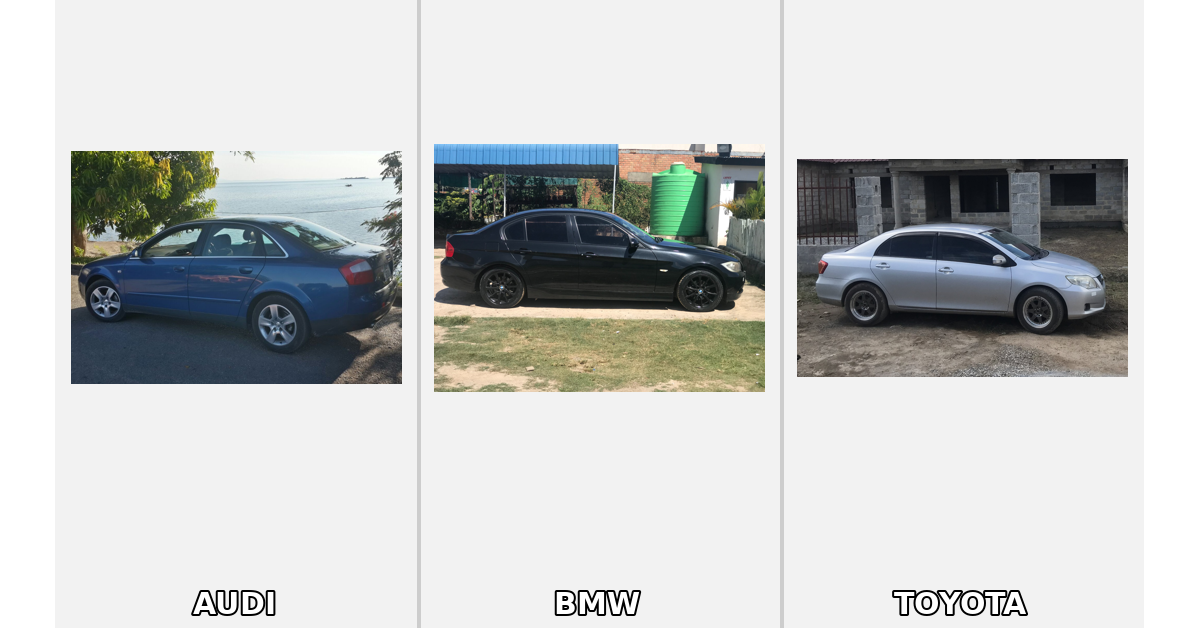
My first car was an Audi A4. I bought it in my first year of work.
I had been waiting for that moment. I had a plan — buy a car within the first twelve months of starting work. And I did it. But if I am honest about why I chose that specific car, it had very little to do with practicality and everything to do with how I wanted to show up. I was a newly employed engineer. Engineers are supposed to make a statement. So I made one.
I did not ask about service costs. I did not think about spares. I did not calculate what the car would demand of me beyond the purchase price. I just wanted to arrive. And I did.
The question was never really about transport. It was about the entrance.
That is a very different question. And it leads to very different places.
The First Lesson I Did Not Learn
The Audi looked good. But it had problems. Gearbox issues that meant sometimes, mid-drive, the car would simply lose speed. There were moments I could not reverse. I had to be conscious of where I parked, how I was positioned, what the road ahead looked like. The engine check light became a regular feature rather than an occasional warning.
And with a German make — especially a secondhand one imported from Japan — every warning light means a diagnostic machine. Three hundred kwacha, five hundred kwacha, just to be told what is wrong. Then the actual fix on top of that. Spares were expensive. Service was expensive. But somehow, because everything was centred around the vehicle, it did not feel that heavy at the time. It felt like just the cost of owning a car.
After about four years, I decided to sell. That was not easy either. The first buyer took it and returned it within two hours, asking for his money back. I eventually found a buyer — but at a fraction of what I had paid. A tiny fraction of the original price.
I should have stopped and asked myself: what did that actually cost me? What did four years with that car teach me about how I was spending?
I did not ask those questions.
Instead, I told myself: it was the Audi. The BMW will be different.
It was not different.
The Subscription I Did Not Know I Had Signed
The BMW 320i — Bima, as every BMW is called locally — was a nicer car. Fancy looking, good to drive when it was running well. My friends called it black on black — the car was black, the windows tinted, the rims I eventually changed to black as well. I had a sound system fitted so that when I was arriving somewhere, people would know before they saw me. I bought BMW-branded shirts. Two pairs of branded shoes — one white, one black, because one pair was not enough for all the occasions. A Mercedes cap. New shades.
None of these felt like decisions. They felt like natural extensions of owning that kind of car. If you are going to drive it, you should look like you belong in it.
The restaurants changed. I had been going to simpler, comfortable places. Now I was going to Chicago’s. The beer shifted from Mosi to Castle Lite. The whiskey moved from Jameson to Glenfiddich. Because the car had set a new standard, and everything around the car had to meet that standard.
There is a phrase my friends would say when I arrived at a gathering. “Buyer abwela.” The buyer has arrived. It was a joke — mostly. But jokes carry weight. When you drive a fancy car in a group of friends, something is understood without being said. You are the one who buys the round. You are the one who picks up the bill when it comes.
I did not always mind. There is something that feels good about being that person in the room. I will not pretend otherwise. When there was a show in town — a big name performing, people travelling for the event — I was there. Sometimes driving out of town just to be seen at the right place with the right car. I am not sure I was always fully conscious of it. But it was happening.
The car did not just change what I drove. It changed what I drank, where I sat, what I wore, and what I felt I had to show up to.
And underneath all of it — the same problems as the Audi. Engine check lights. Suspension costs. Expensive diagnostics every time something blinked on the dashboard. Service bills that kept climbing. Because with German vehicles, nothing is cheap to maintain. And the car was breaking down at a point when I could least afford it to.
I had gotten engaged. My wife and I were in different towns — she in Ndola, I in Kitwe. I was travelling constantly. And now there was a wedding to plan. Real numbers. A future that required a foundation, not a subscription.
So I sat down with my journal and did what engineers do. I ran the numbers. Not just the car payment. Everything the car had been costing me. The bills. The upgrades. The washes. The fuel for two towns. The rounds. The restaurants. The image. All of it on one page.
I kept writing the same phrase, over and over, in a rather frustrated tone.
‘This car is chewing my money.’
I knew what I had to do. But again — it did not sell quickly. I struggled. When I finally found a buyer, the same story as the Audi. A fraction of what I had paid. I had to top up out of my own pocket just to buy the replacement.
Levels
I decided on a Toyota Corolla. And here is something I did not expect: it was not cheap. I had assumed that moving from a Bima to a Corolla meant I would have change left over. I did not. I had to add money. The Corolla cost more than I had imagined.
People had something to say about it. Colleagues. Relatives. The word they used was downgrade. How have you gone from a Bima to a Corolla? You have downgraded. For a manager, a Corolla does not suit you. There was a period where I had to sit with that — the looks, the comments that were not quite comments, the feeling that others were reading the decision as a step backward.
I stayed the course.
Because from the moment I was driving the Corolla, the difference was immediate. Service costs were a fraction of what I had been paying. A straightforward mechanic who did not need a diagnostic machine just to tell me what was wrong. No surprises. No engine lights. No calls from the workshop with unexpected bills. Reliable. Predictable. Honest.
My wife and I noticed it quickly — how much had quietly changed. The money that used to disappear into the car was now staying. We started doing more. Planning more. Breathing more easily. And somewhere in that season, we gave the Corolla a name between ourselves.
We called it Levels. Because what everyone around us called a downgrade, we were living as an upgrade. The car had fewer badges but more peace. Less to prove, and more left over.
Over five years with the Corolla, I was able to do more with my money than I had done in all the years of the Audi and the BMW combined. When I sold it, I sold it at a profit. That had never happened before.
When the time came to buy a car for my wife, she and I sat down together and thought it through properly. We looked at options — including vehicles in the same price range as the fancier alternatives. We chose another Toyota. Not because we could not afford something else. But because we had learned to ask a different question.
Not: what car will tell people who I am?
But: what will actually serve us well, hold its value, and not demand that we become something else to justify owning it?
The Pattern Has a Name — and It Is Not Just About Cars
There is a concept called the Diderot Effect, named after an eighteenth century French philosopher who received a beautiful scarlet dressing gown as a gift. He put it on. He felt wonderful. But then he looked at his desk. Scratched and ink-stained, it suddenly looked wrong beside the robe. So he replaced the desk. The new desk made the rug look shabby. He replaced the rug. The rug made the curtains look cheap. He replaced the curtains. One by one, everything in his life had to rise to meet the standard the robe had introduced.
He ended up broke. He wrote: ‘I was the absolute master of my old dressing gown. But I have become a slave to my new one.’
I did not have a dressing gown. I had an Audi. Then a BMW. Same pattern. Different century. Kitwe, Zambia, not Paris, France.
But this is not only about cars. Think about what happens when a family moves into a new neighbourhood — one slightly above where they were before. The furniture that worked in the old house suddenly looks out of place. The kitchen needs upgrading. The car needs to match the suburb. The children need to go to a different school. The social events in the new circle have a different price point. One decision to move quietly restructures the cost of everything around it.
Or think about someone who gets promoted and, almost automatically, starts dressing differently, eating differently, socialising at a different level — not because they planned to, but because the new position seemed to require it. The salary increase was real. But so were the new expenses. And sometimes the new expenses arrived faster than the new salary could absorb them.
The danger is not in wanting better things. The danger is in not calculating what the better thing will ask of everything around it.
An upgrade in one area has a way of making everything adjacent feel insufficient. And insufficiency, as Diderot discovered, is expensive.
What I Know Now
I am not writing this to say: never buy a nice car, never move to a better neighbourhood, never upgrade anything. That is not the lesson and it is not my experience.
The world will always have an opinion about what you should drive, where you should live, and what your next move should look like from the outside. Some of those opinions will come from people who genuinely care about you. Most of them will be spoken without any knowledge of your actual numbers. Do not let the noise of other people’s expectations make a financial decision for you. The colleagues who said I had downgraded from a Bima to a Corolla did not pay my service bills. They did not sit in the garage waiting for the car to be worked on.
Before you make a significant purchase — before you upgrade your car, your house, your phone, your wardrobe, your social circle — do not just ask whether you can afford the item. Ask whether you can afford everything the item will bring with it.
The true cost of ownership is never just the price tag. It is the price tag plus the cascade — the wardrobe it implies, the circles it invites, the standard it sets for everything it touches.
Budget for the item. But also budget for the Diderot Effect. Because it will come. It always does. And if your total budget — item plus cascade — genuinely works for you, then buy it with confidence. But if the cascade is something you cannot truly absorb, no amount of pressure — external or self-imposed — is worth the frustration of living for the image of something rather than the reality of it.
For me, the journals made the difference. Not because they contained some sophisticated financial model. But because when I was frustrated enough to write honestly — this car is chewing my money, repeated in an irritated hand on a journal page — I was seeing the real picture. And that honest record, sitting in the journal when the next decision came around, meant I did not have to learn the same lesson a third time.
Not all that looks expensive is valuable. And not all that looks simple is cheap.
The Toyota Corolla taught me that. Levels, we called it. And it was.
One Question Before You Go
Is there something in your life right now — a purchase, a decision, a lifestyle upgrade — that has quietly started making everything around it feel insufficient?
You do not have to get rid of it. But it might be worth sitting down, as honestly as you can, and calculating what it is actually costing you. Not just the actual cost of the item. But everything that comes with it.
Because the thing you wrote for yourself, in a frustrated moment, on an ordinary page — that might be the most useful document you ever produce.


Leave a Reply to SYLVIA CHUNGA Cancel reply