My mother kept my report cards.
All of them. Tucked somewhere in the house in that way Zambian mothers keep things — not filed, not archived, just kept, the way important things survive. A birth certificate, a church programme from 1999, a school photograph where everyone is squinting into the sun. When I was home some years ago she put the folder on the table without saying much and left me with it.
I sat down and went through every single one.
The pattern that was hiding in plain sight.
There is a pattern in those cards that is almost funny in how consistent it is. Grade 9, Term Two, 2002 — History: 89%, Grade 1, Excellent result. Civics: 91%, Grade 1, Excellent result. Mathematics: 56%, Grade 3 — and the class teacher, clearly a man who knew where the real story was, used his comment section specifically to encourage me to keep working hard in mathematics. Not history. Not civics. Those were fine on their own. It was the mathematics and sciences that needed the talking to.
And this was not a one-off. Card after card told the same story. The social sciences — History, Civics, Geography, English — came with an ease that I did not earn so much as simply receive. The sciences were a different matter entirely. I could get there most times. But it would take two, sometimes three times the effort to reach results that the humanities handed over without argument.
One at a time, spread across years of growing up, these were just results. You checked the grade, your parents nodded or said something encouraging, you moved on. But all of them together on the table, one after another, they were telling something clearly. The same thing, in the same direction, year after year.
I had just never thought to ask what they were saying.
The subjects that never felt like work.
History, for me, was not a subject. It was a story that kept getting better. Mwata Kazembe holding court in the Luapula Valley. Shaka reorganising an entire army from the ground up — changing how men fought, how they moved, how a kingdom projected power. The way civilisations rose not by accident but by someone, somewhere, deciding to organise people differently. I could sit with those questions for hours. Not because I was disciplined. Because I was genuinely curious. The understanding did not need to be forced. It simply arrived.
Civics worked the same way. Why do countries govern themselves the way they do? How does one event in one place ripple into something that changes a map on the other side of the world? These were not exam questions to me. They were interesting.
I mention this not to go back there and feel good about it, but because that ease — that specific sensation of a subject fitting the shape of your mind — is not nothing. It is data. And data, as I would later be told repeatedly in engineering school, does not care about your feelings. It simply tells you what is true.
The day the headmaster called my name.
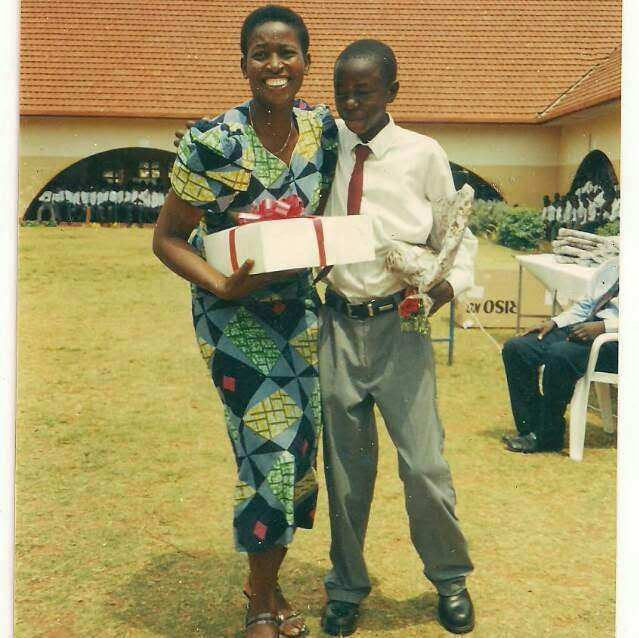
The prize-giving at Kabulonga Boys was around 2002. The school grounds were arranged the way they get arranged for these occasions — students lined up in their clean uniforms, parents gathered, the headmaster Mr Ziwa standing at the front with the particular authority that headmasters carry on days like this. When he announced the prize for best student in History and Civics and said my name, I walked up.
My mother was there. She had the kind of smile that a camera cannot quite manufacture — completely present, completely delighted, holding the gift box with the red ribbon between us. I was standing beside her trying to look composed the way a thirteen-year-old tries to look composed when he has just been called out in front of everyone. Trying, also, not to look too much like a mama’s boy in front of his classmates. She was very excited. I was very happy and also very aware of my friends watching.
It is a good photograph. But what it does not show — what no photograph can show — is that at no point during that entire day did it occur to me to connect what I had just been recognised for with what I might do with my life.
Not even for a moment.
The picture in my head was already complete.
Because I already knew what I was going to do.
There was an engineer who lived in my neighbourhood in Kamwala, and he left quite an impression on me. I do not remember exactly when I started paying attention to him, but children notice these things — the car, the house, the general impression of a life that has arrived somewhere. He worked for ZESCO. And the thing about ZESCO engineers, as everyone knew those days, was that they earned serious money. This was not a rumour. This was neighbourhood fact, the kind that gets repeated with the quiet authority of something settled.
In my mind, the picture assembled itself completely and without effort: this is what success looks like. This is what you work towards.
And there was something else layered on top of that picture. The brilliant students — the ones who got the distinctions, the ones the teachers pointed to — they did engineering. Or they did medicine. Those were the destinations that a certain kind of academic performance was supposed to lead to. Social sciences were not in that conversation. Not because anyone sat me down and said so explicitly. It was simply understood, the way many things are simply understood when you are young and absorbing the world around you.
The report cards were on one side of the table. The picture in my head was on the other. The picture won, and it was not even a competition. The decision did not feel like a decision at all. It felt like common sense.
Which is, of course, exactly how these things work.
“You were sold too.”
I wrote about this in 2021 — back when this writing was just beginning to find its voice — after a phone call with an old friend from school. We had been classmates from junior secondary all the way through high school, and we were at the age where conversations had stopped being about what people were doing and started being about why we had done the things we had done.
He told me that in high school, biology and chemistry had genuinely interested him. That he had liked those subjects. But he had gone into accountancy.
I asked him why.
He laughed and said a classmate had once made a remark — casual, completely offhand, the kind of thing a teenager says without any idea of the weight it carries — about accountants at KCM and Mopani pulling K40 pin per month.
“And just like that I was sold,” he said.
We laughed about this for a while, the way you laugh at something that is funny and also slightly uncomfortable. Then he asked about my path. I told him about the ZESCO engineer. About the picture I had formed as a child, without quite knowing I was forming it. About the report cards that had been saying something consistently for years that I had never paused to read.
He was quiet for a moment.
“You were sold too,” he said.
We laughed again. But that phrase sat with me for a long time after the call ended. Because the interesting thing about being sold something is that it never feels like a sale. It feels like your own idea.
The evidence was always there.
The data was consistent for years. The evidence was in the folder. Every teacher across every school was pointing in the same direction, reliably, without coordination, simply by recording what they observed. And none of it was consulted when the actual decision was made — not because it was hidden, but because the picture in my head of what a successful life looked like was already so complete that there was no question left to ask.
This is not unusual. In fact it is remarkably common. The parent who decides that medicine is the only destination for a child who shows any academic ability. The uncle whose career becomes the template for the next generation. The classmate who mentions K40 pin at exactly the right moment. Most of us do not choose our paths so much as we absorb them. We look around at what success appears to look like in our immediate world, and we aim at that picture, and we call it a plan.
The report cards are still in the folder.
Whose picture was in your head?
The question I keep returning to is not what should I have done differently. That road goes nowhere useful.
The question is simpler and more uncomfortable than that.
What data do you have about yourself — consistent, reliable, quietly accumulated across years — that you have never actually sat down and read? Because it is probably there. In the subjects that never felt like work. In the tasks you finish and somehow still have energy left. In the things people keep asking you for help with, not because you advertised, but because you are apparently the person who does that well.
The evidence has a way of accumulating patiently, in folders and in memory, waiting for the day you decide to open it.
Whose picture was in your head when you made your biggest decisions? And was it yours?
I would genuinely like to know. Leave a comment below.


Leave a Reply to Thomas Sinkala Cancel reply