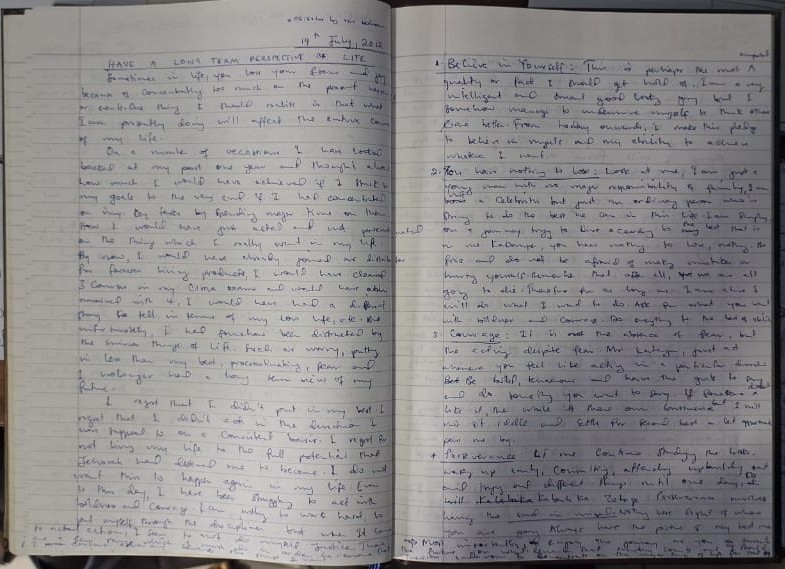
“Sometimes in life, you lose your focus and joy because of concentrating too much on the present happenings or events. One thing I should realise is that what I am presently doing will affect the entire course of my life.”
I found that line this morning.
Written in my handwriting. July 14th, 2012. A journal I have not opened in years.
I was 23. Final weeks at the University of Zambia. Sitting at Goma Lakes overlooking the water, writing to my future self.
That future self is me. Sitting at my dining table. Sunday morning. 6am. Before my daughter wakes. Before my wife stirs.
Fourteen years later.
And my younger self had something to say that I was not sure I wanted to hear.
The Warning I Wrote to Myself
The entry was titled: “Have a Long Term Perspective of Life.”
Bold. Underlined. The kind of title you give something when you have just figured out what matters and need to make sure you never forget.
He went on:
“On a number of occasions I have looked back at my past one year and thought about how much I would have achieved if I stuck to my goals to the very end.”
Then he listed them. The things he started but did not finish.
Forever Living Products distributor application — I smile at that one now, but at the time it felt like the key to everything. CIMA courses he let slide. Areas of life where he settled instead of pushed.
“But unfortunately, I had somehow been distracted by the minor things of life. Such as worry, putting in less than my best, procrastinating, fear, etc.”
I had to stop reading for a moment.
Because this was not written by someone failing.
This was written by someone doing reasonably well but noticing — with uncomfortable clarity — that he was not taking action on what he said mattered.
Fourteen years later, reading those words, I realized something.
I have been doing exactly what he was afraid of.
Four Things He Knew at 23
He wrote down four things he needed to remember. Four anchors to keep himself from drifting.
I read them now and they land differently than they did when he wrote them.
-
Believe in Yourself
“I am a very intelligent and smart good looking guy but I somehow manage to undermine myself to think others are better.”
The confidence makes me smile. The honesty about self-doubt does not.
Because that part is still true to some extent.
At 23, he already saw the pattern. Assuming others had something he did not. Waiting for permission that nobody was actually withholding except himself.
Fourteen years later, I am still doing it.
-
You Have Nothing to Lose
“Look at me, I am just a young man with no major responsibility of family… Kakompe, you have nothing to lose, nothing. Be free and do not be afraid of making mistakes.”
This one hits hardest.
Because he was right. At 23, he had nothing to lose.
And now, 14 years later, with a family and obligations and routines that work — I do have things to lose.
But somewhere in acquiring those things, I also stopped trying things.
Not because I became reckless or lazy. But because life became comfortable.
And comfort, when you stop examining it, becomes a cage you do not notice.
-
Courage
“It is not the absence of fear, but the acting despite fear. Just act whenever you feel like acting in a particular direction.”
Courage is not confidence.
It is action despite fear.
-
Perseverance
“Let me continue studying the books, waking up early, committing, attending relentlessly… and trying out different things until one day, it will click. Most importantly, to enjoy the journey as you go forward. Remind the future self that everyday counts.”
I am the future self he was writing to.
And I am not sure I have been listening.
Why This Stopped Me
I have dozens of these journals.
Notebooks from university. From different seasons of life I barely remember now.
For years they sat on a shelf. Closed. Waiting.
I told myself I would go through them when I had time.
But time does not arrive. You create it. Or you do not.
Recently I started opening them again. Not all at once. Just one every few weeks. Reading what my younger self was thinking. Noticing what he was paying attention to.
And what I keep finding is this:
He was asking better questions than I was asking for a long time. Before I started paying attention again.
He was asking: What do I actually want?
For years, I was asking: What needs to get done today? What gets me paid at the end of the month?
He was thinking in years.
I was thinking in months.
What He Did Not Know
My 23-year-old self was onto something.
But he also had no idea how complicated life would become.
Not in a bad way. Just in the way life always does when you go from theory to practice.
He thought the main challenge would be discipline. Sticking to goals. Not procrastinating.
He did not know that the real challenge would be simpler and harder at the same time.
That time would move faster than he expected. That years would pass in what felt like months. That he would blink and suddenly have a family, obligations, routines that work but also quietly calcify if left unexamined.
That life would give him exactly what he worked for — stability, comfort, good outcomes — and that those good things would make it harder to remember what else he wanted.
Not because they were wrong. But because they were enough.
And “enough” is where most dreams go to rest.
The Thread
If you have been reading these reflections, you have probably noticed a pattern.
How routine becomes inertia if not examined.
How life flattens when you stop creating experiences worth remembering.
How good work stays hidden if you never share it.
How you can give everything to everyone else and forget to give anything to yourself.
All of them are versions of the same question my 23-year-old self was asking at Goma Lakes:
Am I living with a long-term perspective, or am I just getting through the day?
I have been doing better lately. Paying more attention. Acting more deliberately.
But this journal entry is a reminder that the questions never stop mattering.
That staying awake requires effort.
What We Remember
We do not need to abandon everything we have built.
We do not need to quit our jobs or blow up our lives or chase every dream our younger selves had.
Some of those dreams were naive. Some were impractical. Some were exactly right for who we were then but completely wrong for who we are now.
What we need is simpler.
To remember that we once asked bigger questions. That we once thought in years, not months. That we once believed we had nothing to lose and everything to try.
Long-term thinking is not abstract. It is specific.
It is the side project you start today knowing it will take three years before anyone notices. The skill you commit to learning not because it helps this quarter but because it positions you for the next decade. The relationship you invest in slowly, knowing trust compounds over years not months.
It is planting trees whose shade you may never sit under.
Not because the outcome is guaranteed. But because ten years from now, you will either have spent that time building something that matters or you will have spent it getting through each month.
The time passes either way.
And to ask ourselves — honestly, without judgment — whether any of those questions are still worth asking now.
Not because we have to act on them.
Just because remembering what we cared about before life got comfortable is worth something.
Even if all it does is remind us that we are still allowed to care about things beyond what is immediately in front of us.
If you could hear what your younger self was thinking ten years ago — what would they remind you that you have forgotten?
Would they recognize you?
Would they be proud?
Or would they wonder — quietly, without judgment — when you stopped thinking long-term and started just getting through each month?
I do not know what your younger self would say to you.
But mine is saying something I needed to hear:
“You have more to lose now. But you also have more to give. Do not let comfort become the reason you stop asking what else is possible. Remember — everyday counts.”
He was right then.
He is still right now.
Leave a Reply