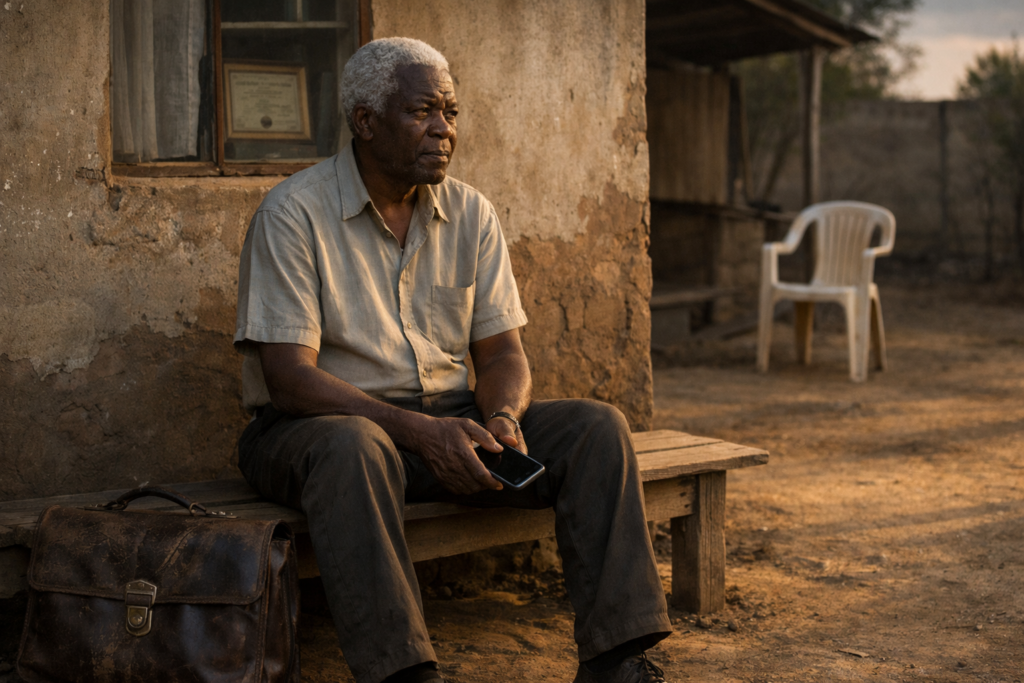
At 75, he thought he would be resting.
Not like this.
He had done everything right. Three children. A banker. A doctor. An engineer. He paid their fees without complaint. Sent one abroad. Watched them graduate. Watched them build their own lives.
He thought he had succeeded as a father.
And he had.
But today he lives alone in Chinkuli Village in Chongwe. The career is gone. The strength is fading. The house is quiet in the way that only comes from a very long time without visitors.
His phone sits beside him most evenings. Not because he is waiting for it to ring.
Just because it rarely does.
His children are not bad people. They have their own school fees now. Their own building projects.
Which is exactly what he raised them to do.
He just never made a list for himself.
A day later, another story arrived.
A man still in the thick of it. Running three jobs simultaneously — the main job, the side hustle, the deals on the side. Chasing ichola the way a lot of us do when the school fees are due and the building project needs another phase and the family needs this and the relatives need that.
His body eventually said enough.
One week away from a stroke, the doctor told him.
But that was not the only thing unraveling. The relationship — stretched thin by years of a man who was always somewhere else — was ending. And the property they had built together, years of real sacrifice and real money, was tied up in arrangements nobody had ever properly discussed.
He walked away with far less than he put in.
Not because of malice.
Because the conversation had never happened.
Two men. Two different seasons of life.
One thread running quietly through both.
They were the last people on their own list.
The Portfolio Nobody Audits
Most of us are serious investors.
Career — deliberate. Years of studying, positioning, sacrificing.
Children — no expense spared. The best schools we can afford. Sometimes more than we can afford.
Property — every bonus accounted for. Every phase of construction followed closely.
And then there is us.
Our health. Our rest. Our plan for the season of life when the salary stops and the body finally presents the bill for everything it was quietly owed.
That portfolio — most of us manage it last. Myself included.
We tell ourselves we will get to it. After the house is done. After the children finish school. After things settle.
But things do not settle. They just move faster.
And the cost of neglecting this particular portfolio does not announce itself early.
It accumulates quietly.
Until one day it presents the full bill at once.
What Retirement Actually Looks Like
Here is something we do not talk about enough.
Retirement is not the finish line. It is a season. And like every season, it rewards whoever prepared for it.
The engineer who retires does not stop understanding systems. The banker does not stop understanding money. The doctor does not stop knowing medicine. That knowledge — built over thirty or forty years — is worth something long after the salary stops.
Imagine retiring and walking into a lecture hall at the University of Lusaka. Not because you need the income. Because you chose to be there. Passing on what took you decades to learn to people hungry for exactly that.
Or a small farm outside Lusaka. Hands in the soil. Something growing. Something yours.
These are not consolation prizes. They are what a prepared retirement looks like.
But they require groundwork. Not at sixty. Now. Slowly. Quietly. Alongside everything else.
Because if you do not plan that season, the grinding does not stop when the salary does.
It just continues — without the salary that used to make it worthwhile.
And you will find yourself working not because you chose to.
But because you have no choice.
The Conversations Most Couples Are Avoiding
I will be honest — this part is not about other people.
It is about most of us. Myself included.
Most couples are remarkable at building together. The house. The children. The future constructed side by side with genuine love and genuine effort.
But the specific conversations — the ones about the structure underneath all that building — those get quietly postponed. Not out of distrust. Just because things are good right now and it feels unnecessary.
Whose name is this property in? And why?
If something happened to one of you tomorrow — illness, incapacity, death — what does the other one actually own? What does the paperwork say, not what the intention was?
If assets are in a child’s name for convenience — which seems practical today — what happens when that child is grown, married to someone you did not choose, living a life you did not plan for?
Zambia has seen enough of these stories. Businesses built by genuine partners that ended up in court because the agreements were only ever verbal. Family properties that became battlegrounds not because anyone was evil but because nothing was ever written down when things were good.
A marriage is not a business. But what you build inside one deserves the same clarity.
Not to protect yourself from your partner.
To make sure that whatever you are building together actually belongs to both of you. That neither of you ends up exposed by something you never thought to discuss while things were still good.
Because moving through life on autopilot is costly in many areas.
Inside a relationship, the cost tends to surface at the worst possible time.
The Other Man
There is another man I want you to picture.
Same age as the one in Chinkuli. Same generation. Also gave everything to his family. Also paid school fees. Also showed up for everyone who needed him.
But somewhere in all the giving, he also gave something to himself.
Not extravagantly. Just consistently.
He saved quietly alongside everything else. He had conversations with his wife about what they owned and whose name it was in and why. He started laying groundwork — slowly, without fanfare — for what he wanted his later years to look like.
Today he walks into a lecture hall at the University of Lusaka twice a week. The students call him Professor. He does not need the stipend. He goes because thirty years of hard-won knowledge deserves somewhere to land.
On weekends, a small plot just outside town. Something growing. Something his.
He does not sit waiting for his phone to ring.
He is usually too busy to notice.
Same starting point as the man in Chinkuli.
Very different arrival.
As you live the present — paying attention to the data your own life is generating — pay attention to this blind spot too. The one that never feels urgent because there is always something more pressing today.
You are allowed to take care of yourself. Not at the expense of the people you love. Just not at the expense of yourself either.
Leave a Reply